Age-of-Majority Alerts for Financial Advisors
Financial advisors can track markets, portfolios, and tax events, yet one of the most predictable moments in a client relationship can still arrive unnoticed: a child turning 18. That birthday can change the rules around UTMAs, teen brokerage accounts, 529s, new 530A accounts, and other assets connected to the child, with requirements varying by state, custodian, and account type. **The Age-of-Majority Alert** would let an advisor upload their client households once, then automatically watch for these transitions. Ninety days before a child reaches the relevant age, the advisor gets a one-page brief showing every affected account, what happens next, important deadlines, and a draft message to the parents. A $50–$150 monthly subscription turns a date advisors often discover after the fact into a planned conversation with the family and a natural first meeting with the next generation. The product itself could be three screens. The asset is the rules engine underneath it: a constantly updated map of what happens to every youth-linked financial account, at every relevant age, in every state, across every major custodian.
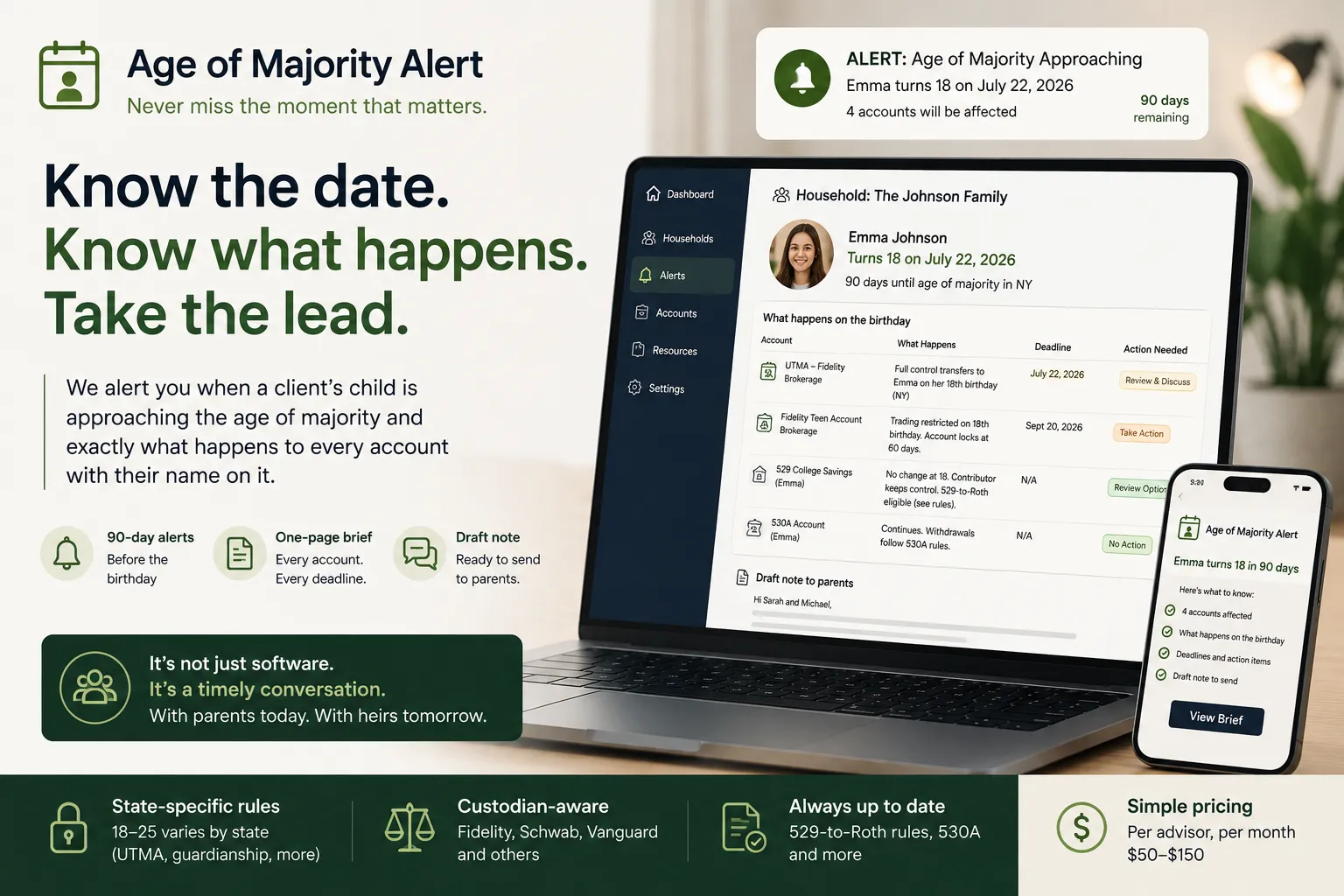
Description
No additional description provided.
The Pitch
Turns a small administrative detail into a trust-preserving ritual. The child’s 18th birthday is not financially exotic, but it is emotionally loaded: parents are confronting legal adulthood, control is shifting, and advisors have a rare excuse to discuss family money without sounding opportunistic. Many advisory relationships are lost not because of poor portfolio management, but because the advisor is invisible at precisely the moments when money becomes personal.
The interesting asymmetry is that the advisor does not need a high-frequency product here. They need a product that is right once. A missed transition can create embarrassment, compliance concern, awkward client conversations, or a lost chance to build a relationship with the child. A correctly timed alert, by contrast, feels almost magical because it anticipates a problem the client did not know existed. That makes the software valuable less as a workflow tool and more as a memory prosthetic for the advisory firm.
The deeper asset is not the reminder; it is the interpretation layer between fragmented rules and a specific household. Financial life is full of age-triggered thresholds, but most systems store dates without understanding their consequences. Custodians know accounts, CRMs know people, tax software knows forms, and advisors are left to connect the meaning by hand. A company that maps “this child, in this state, with these accounts, at this birthday” into plain next steps owns a surprisingly scarce kind of operational intelligence.
It also fits the economics of advisory work because one saved relationship can justify years of subscription cost. Advisors already pay for tools that help them manage investments; this would help them manage continuity. That distinction matters. The hardest problem in wealth management is not finding the next asset allocation, but remaining the family’s advisor after wealth changes hands. The age-of-majority moment is one of the earliest rehearsals for that transfer.
The business works because it is narrow enough to be trusted. A broad “life events platform” would become vague and ignorable; a precise system for legally significant birthdays can become part of the firm’s professional hygiene. The best financial software often wins by making advisors look prepared in front of clients. This idea does that at a moment when preparedness feels less like efficiency and more like care.