Adversarial Robustness Testing for Research Studies
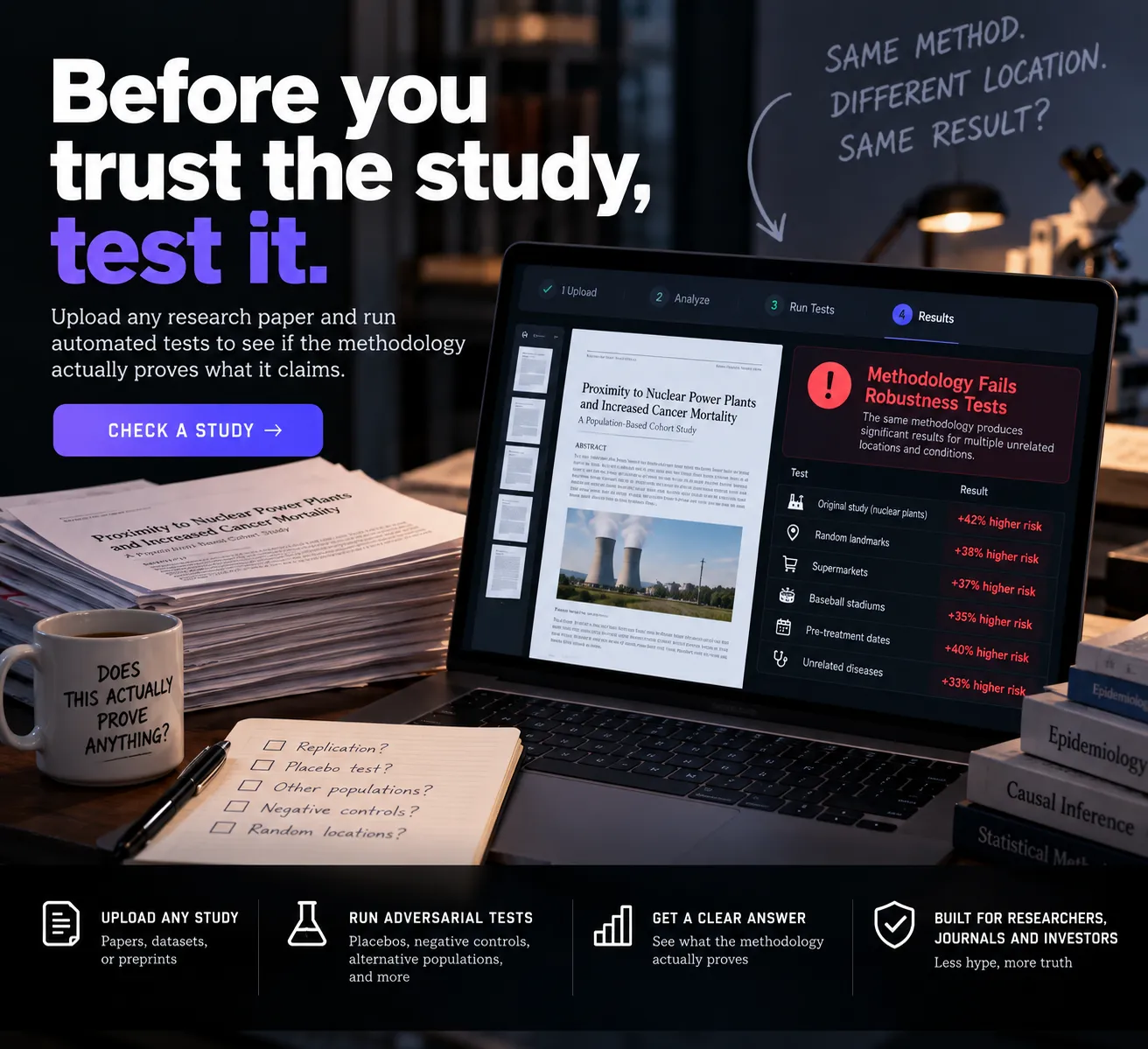
Research can look rigorous, use sophisticated statistics, and still produce completely meaningless conclusions because the underlying methodology is flawed. Build software that actively tries to disprove a study before anyone trusts it. Upload a paper or dataset and the system automatically runs placebo tests, negative controls, alternative populations, fake treatment dates, random landmarks, and other adversarial checks to see whether the methodology keeps finding effects that should not exist. This is newly possible because AI can understand research methods while modern statistical tooling can rerun dozens of robustness tests automatically instead of requiring another researcher to spend weeks reproducing the work. Imagine uploading a study claiming people near nuclear plants have higher cancer rates and discovering that the exact same methodology also finds higher cancer rates around supermarkets, baseball stadiums, and random GPS coordinates. That’s a product that needs to exist.
Description
No additional description provided.
The Pitch
Sell doubt as a product in a world that mostly sells confidence. The market is full of tools that help researchers analyze data, format papers, visualize findings, or claim statistical significance. Far fewer tools are designed to ask the hostile question: “If this method were wrong, how would we know?” That inversion matters because modern knowledge work increasingly fails not through fraud, but through procedures that are defensible one step at a time and absurd in aggregate.
A compelling company here would become a kind of crash-test facility for evidence. Cars were not made safe by asking manufacturers whether their designs seemed reasonable; they were made safe by repeatedly smashing them into walls under standardized conditions. Research needs the same ritual. The value is not merely catching bad papers, but creating a visible expectation that claims should survive contact with adversarial tests before they are treated as facts. Over time, passing those tests could become as meaningful as peer review, perhaps more so, because it examines the machinery of the claim rather than the persuasiveness of the prose.
The business works because the cost of being fooled is rising. Policy, medicine, litigation, finance, and corporate strategy all rely on studies whose conclusions can move billions of dollars or alter public behavior. Yet the person making the decision is often not equipped to inspect the statistical plumbing. They do not need another dashboard; they need a methodological immune system that can flag when an impressive result behaves suspiciously well in places where no effect should exist. In that setting, the product is valuable because it translates technical fragility into institutional caution.
There is also a deep asymmetry in the labor. Producing a fragile study can be cheap, especially when researchers can try many specifications and report the attractive one. Disproving it properly is expensive, slow, and unrewarded. Software changes that balance. If adversarial replication becomes fast enough to run by default, the culture around evidence shifts: the burden moves subtly from “can you produce significance?” to “can your method stop hallucinating significance?”
The enduring company would not be a research assistant; it would be a trust boundary. Any institution that consumes evidence at scale eventually needs a way to distinguish findings that are merely well-presented from findings that are hard to fool. That distinction is becoming too important to leave to taste, reputation, or reviewers with limited time.