Activated Distribution Analytics for Partnership Channels
Companies say they have millions of customers available through partners when most of those customers may never encounter the product. There is no standard way to distinguish contracted distribution from producing distribution. Activated Distribution Score would measure each layer: total partner footprint, reachable users, eligible transactions, product exposure, action and revenue. Why now: partnership channels are becoming large enough that boards and finance teams need the same rigor they already expect from paid acquisition and direct sales. Example: a fintech claims access to 8 million users through 150 bank partners. The score shows only 1.9 million are reachable, 600,000 ever see the product and 90,000 actually use it. Suddenly the growth problem is measurable.
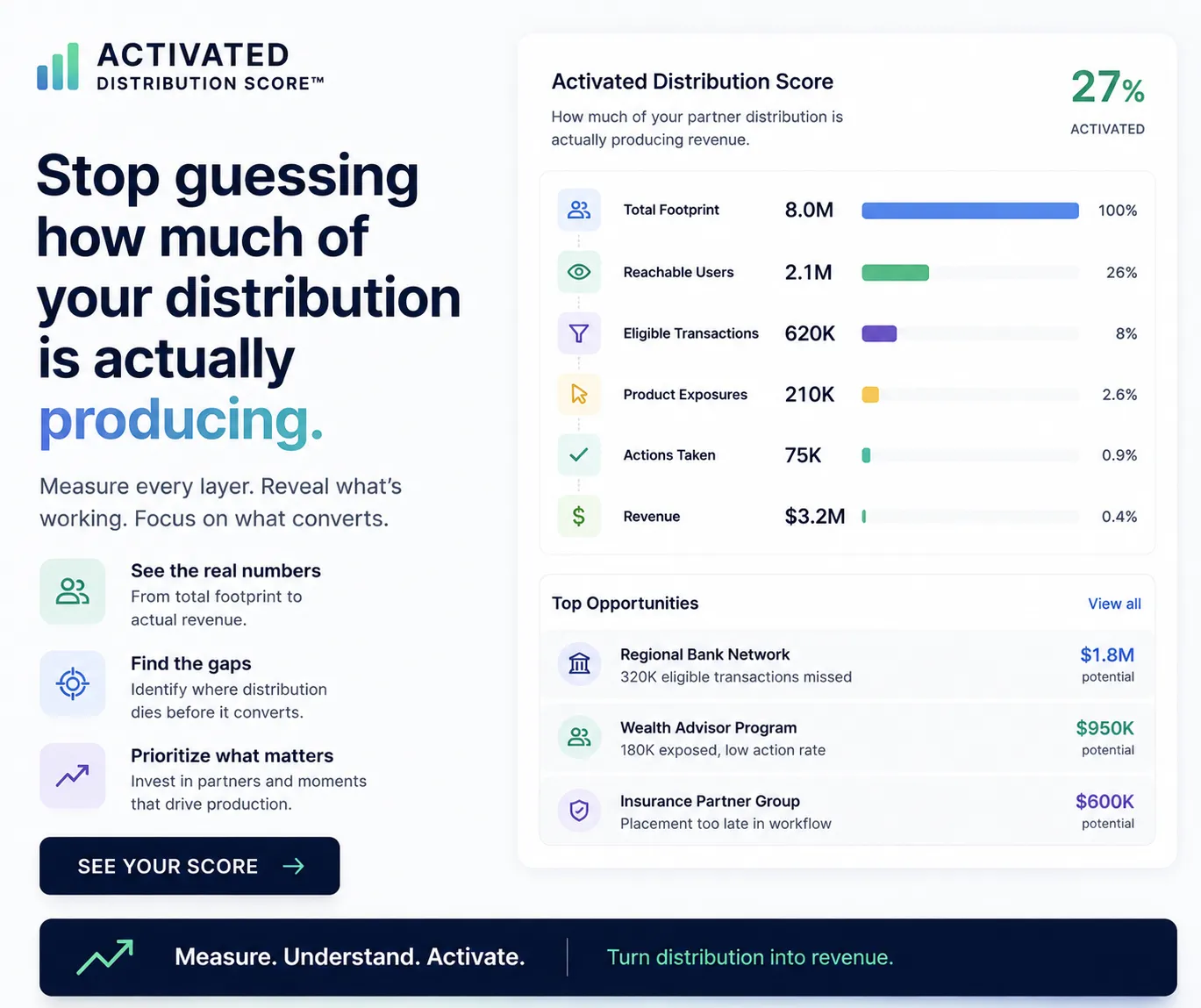
Description
No additional description provided.
The Pitch
Distribution has always been treated as a story until money makes it embarrassing. A company can spend years accumulating logos, integrations, reseller agreements, marketplace listings, and channel partnerships, while the actual customer path remains foggy. The compelling business here is not measurement for its own sake; it is converting partnership optimism into an operating asset that finance, product, and commercial teams can argue about using the same numbers.
The non-obvious wedge is that partner channels fail less often at the contract level than at the “missing middle.” The agreement exists, the integration technically works, the partner has customers, and yet almost nothing happens because the product is buried, ineligible, unmentioned, poorly timed, or operationally invisible. That middle layer is where most distribution value evaporates, and today it is rarely owned by anyone. A score that names those leaks creates a new management category: not partnerships, not marketing, not sales, but distribution productivity.
This would also change incentives inside companies. Without a shared measure, partnership teams are rewarded for signed reach, product teams prioritize direct users, and finance discounts the whole channel because it cannot see cause and effect. A credible distribution score would make partner relationships comparable to each other and comparable over time. The important shift is psychological: once executives can see that one partner with 200,000 exposed users is worth more than ten partners with five million theoretical users, the prestige of partnership volume starts to decay.
The business could become especially durable because the data is hard to assemble from any single system. Contracts know footprint, product logs know exposure, partner systems know eligibility, finance knows revenue, and none of them naturally agree. The value sits in stitching these partial truths into a trusted chain of evidence. Once that chain exists, it becomes the record of how indirect growth actually happens, not just a dashboard layered on top of it.
The best version of this company would make inflated distribution claims socially difficult. It would do for partnerships what funnel analytics did for websites: turn a vague promise of access into a sequence of observable drop-offs. That kind of measurement tends to become permanent because, after a company sees the real shape of its distribution, going back to anecdotes feels irresponsible.