Acqui-Hire Fairness Analysis Software
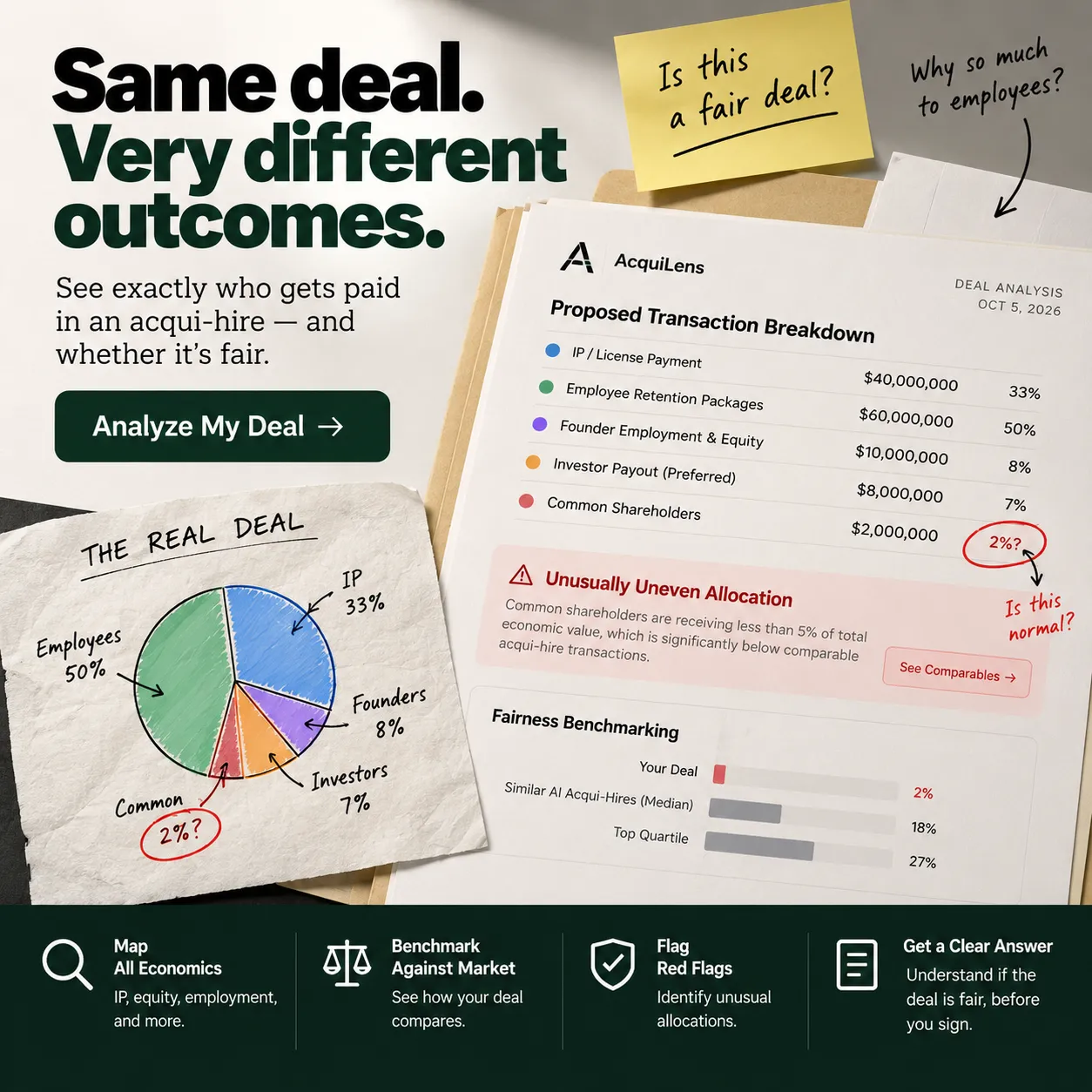
Acqui-hires can look like simple startup sales even when the real economics are scattered across IP licenses, retention packages, employment agreements, investor payouts, and whatever value remains in the company, making it hard to tell who actually got paid and whether the deal was fair. Build a fairness engine that ingests the cap table and proposed transaction, reconstructs the total economic value flowing to every stakeholder, and flags unusually lopsided outcomes before the deal closes. This becomes more important now as AI companies increasingly use creative acquisition structures to buy talent and technology without traditional M&A, while courts are only beginning to establish what fair treatment looks like. Imagine a startup being offered $40 million for its IP while three key employees receive another $60 million in retention grants and common shareholders get almost nothing, and the software instantly showing how far that allocation deviates from comparable deals. That's a product that needs to exist.
Description
No additional description provided.
The Pitch
Acqui-hires are not one transaction; they are a bundle of related transactions that are deliberately easiest to understand in pieces. A board may approve an IP sale, employees may separately negotiate compensation, investors may receive a small liquidation preference, and common holders may be told the company had no meaningful standalone value. Each component can look defensible on its own, while the combined picture tells a different story. A business that can reconstruct the whole economic event would create value because the truth of these deals lives in aggregation.
The strongest customer need comes from the asymmetry of information at the moment when people are least able to challenge it. Founders, employees, angels, and minority investors often discover the real allocation only after terms are largely set, and their alternative is hiring expensive counsel to manually reverse-engineer the transaction under time pressure. The product would not need to replace lawyers; it would make the first-order economic reality visible enough that everyone enters the legal conversation with the same map.
This is especially interesting because “fairness” in these transactions is becoming a data problem before it becomes a legal standard. Courts and boards tend to reason from comparables, norms, process, and conflicts of interest, but those reference points are fragmented and private. A company that accumulates structured knowledge of how value is typically divided across deal types, seniority, ownership, IP contribution, and retention importance could become the informal measuring stick for an area where almost nobody knows what normal looks like.
The business also benefits from a rare alignment between moral pressure and economic self-interest. Boards, acquirers, and counsel do not want a deal to unravel later because someone can credibly argue that value was hidden in side agreements. A pre-closing analysis that identifies the appearance of unfairness is not just protection for weaker stakeholders; it is insurance for the stronger ones against future litigation, employee resentment, and reputational damage. The product becomes useful precisely because it makes uncomfortable facts legible early.
What makes the opportunity durable is that creative acquisition structures are likely to keep evolving faster than governance norms. The more buyers avoid conventional M&A, the more value moves through compensation, licensing, consulting, earnouts, and employment promises rather than headline purchase price. That creates a recurring need for a neutral translation layer: not a database of announced deal values, but a system that answers the only question that really matters in these situations—where did the money actually go?